
Types of synapses
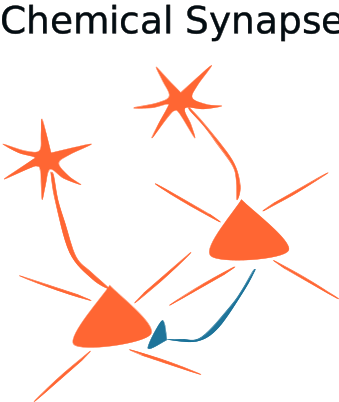
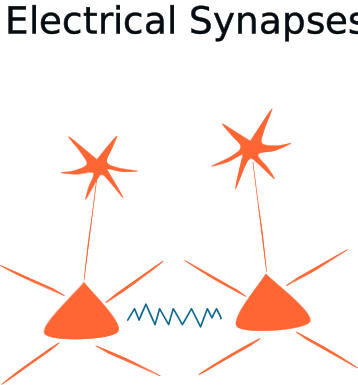

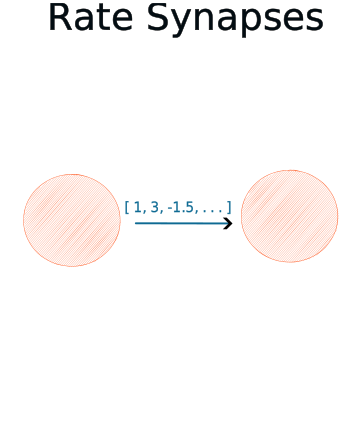
In the following section, we introduce the different types of synapse model implemented in NEST. This page focuses on the type of signal transmission and plasticity for each synapse model. For details on the post-synaptic response dynamics of synapses, see Synapse dynamics. Some synapse models require specific neuron types, which is indicated in the model description. While various synapse types can theoretically be combined, implementation limitations exist in NEST. For custom synapse models, consider using NESTML.
Chemical synapses
The majority of synapse models in NEST implement chemical synapses.
Signal transmission type: Unidirectional spike transmission from pre-synaptic to post-synaptic neuron
Weight and delay: Characterized by a (plastic) weight and (static) delay
Synaptic weight: Various mechanisms can change the synaptic weight over time, see Types of plasticity below.
Delay: Represents electrochemical signal conversion and signal propagation from synapse to postsynaptic soma.
In NEST, delays are considerd fully dendritic, with one exception:
stdp_pl_synapse_hom_ax_delay. This synapse model supportsaxonal_delayanddendtritic_delayparameters. For more information, see Delays and Example using axonal delay >>>> PR 2989!
Types of plasticity
Static synapses

Connection does not change over time.
Static synapses
static_synapse - chemical, static
static_synapse_hom_w - chemical, static
Functional plasticity

Connection weight changes over time.
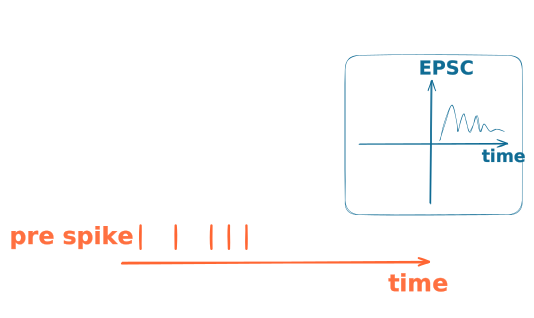
Short-term plasticity (STP)
Depends only on presynaptic neuron spiking activity
Can exhibit either facilitation (increased response) or depression (decreased response)
STP synapse models
{% for items in tag_dict %} {% if items.tag == “stp” %} {% for item in items.models | sort %} * /models/{{ item | replace(“.html”, “”) }} {% endfor %} {% endif %} {% endfor %}
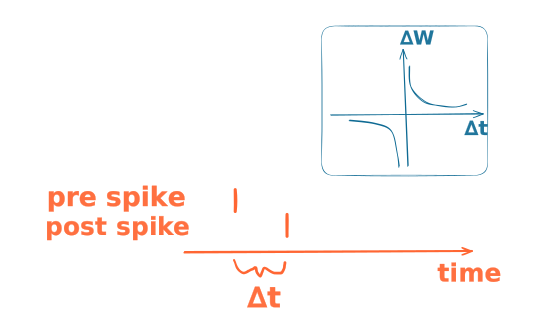
Spike timing dependent plasticity (STDP)
Depends on the relative timing of pre- and post-synaptic spikes
The effect can be either additive or multiplicative, depending on the specific implementation
Different window functions determine the temporal dependence of plasticity
STDP synapse models
{% for items in tag_dict %} {% if items.tag == “stdp” %} {% for item in items.models | sort %} * /models/{{ item | replace(“.html”, “”) }} {% endfor %} {% endif %} {% endfor %}
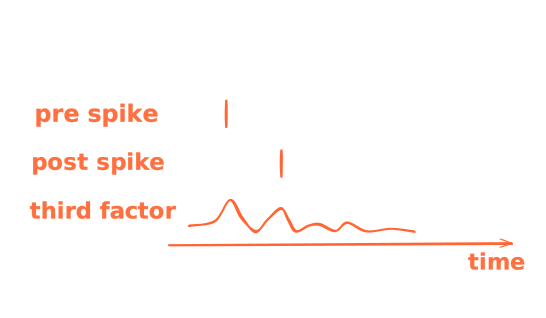
Spike timing dependent plasticity and STDP-like models with third factors
The third factor modulates the effectiveness of synaptic weight changes
This third factor can be a neuromodulation signal or a local signal from the postsynaptic neuron, such as membrane potential or dendritic voltage
Synapse models with 3rd factors
{% for items in tag_dict %} {% if items.tag == “static” %} {% for item in items.models | sort %} * /models/{{ item | replace(“.html”, “”) }} {% endfor %} {% endif %} {% endfor %}
Structural plasticity

Synapses are dynamically created or deleted.
Example using structural plasticity in NEST
Stochasticity
Spike transmission in chemical synapses is not always reliable due to diffusion of neurotransmitters and stochastic
neurotransmitter release. Most synapse models in NEST use deterministic signal transmission; however,
the bernoulli_synapse implements stochastic spike transmission.
bernoulli_synapse - chemical, static, stochastic
Electrical Synapses
Signal transmission type: Voltage
Electrical synapses provide direct electrical coupling between the membranes of two neurons, resulting in instantaneous signal transmission. The strength of coupling is determined by the conductance. Unlike chemical synapses, signal transmission is bidirectional. These synapses are typically considered static and deterministic.
Instantaneous coupling requires waveform relaxation (WFR)
This is enabled by default (
use_wfr = True)Most users don’t need to change any settings
For advanced configuration options, see the Simulations with gap junctions documentation
Available models: gap_junction - electrical
Astrocytic coupling
Signal transmission type: Current
Astrocytic coupling modulates neuronal activity by producing slow inward currents to neurons, which in turn are affected by neuronal activity. This creates a recurrent interaction between astrocytes and neurons.
Available models:
sic_connection - astrocyte
Rate connections
Signal transmission type: Firing rates
Rate neurons transmit continuous signals representing firing rates between neurons.
Rate neurons are used with rate-based neuron models for efficient population-level simulations.
Rate connections with delay buffer information during the minimum delay period and send it as a packet
Other connections submit single values instantaneously
Available models:
cont_delay_synapse - abstract, rate
diffusion_connection - abstract, rate
rate_connection_delayed - abstract, rate
rate_connection_instantaneous - abstract, rate
Auxiliary synapses
Signal transmission type: Learning signals and other continuous signals
Auxiliary synapses are models without direct biological counterparts, typically used with complex plasticity models requiring learning signals between neurons (e.g., e-prop). They typically submit arrays of continuous signals.
Connections submit single values instantaneously
Available models:
eprop_learning_signal_connection - abstract, learning
eprop_learning_signal_connection_bsshslm_2020 - abstract, learning
eprop_synapse - abstract, learning
prop_synapse_bsshslm_2020 - abstract, learning
clopath_synapse - chemical, functional, stdp, 3-factor
ht_synapse - chemical, functional, stp
jonke_synapse - chemical, functional, stdp, 3-factor
quantal_stp_synapse - chemical, functional, stp
stdp_dopamine_synapse - chemical, functional, stdp, 3-factor
stdp_facetshw_synapse_hom - chemical, functional, stdp
stdp_nn_pre_centered_synapse - chemical, functional, stdp
stdp_nn_restr_synapse - chemical, functional, stdp
stdp_nn_symm_synapse - chemical, functional, stdp
stdp_pl_synapse_hom - chemical, functional, stdp
stdp_synapse - chemical, functional, stdp
stdp_synapse_hom - chemical, functional, stdp
stdp_triplet_synapse - chemical, functional, stdp
tsodyks2_synapse - chemical, functional, stp
tsodyks_synapse - chemical, functional, stp
tsodyks_synapse_hom - chemical, functional, stp
urbanczik_synapse - chemical, functional, stdp, 3-factor
vogels_sprekeler_synapse - chemical, functional, stdp, 3-factor