
Synapse dynamics
The dynamics of synaptic interactions between neurons can be characterized in terms of three distinct factors:
the postsynaptic response to a single, isolated presynaptic spike,
the dynamics of synaptic weights (aka synaptic plasticity), as well as
their across-trial variability (aka synaptic stochasticity).
This page focuses on the postsynaptic response dynamics. Please visit Types of synapses for plasticity and stochasticity in NEST.
Postsynaptic response to a single presynaptic spike
Voltage dependence
Current-based synapses
Current-based synapses model an input current \(I_\textrm{syn}(t)\) that is fed as an additive term in the equation for the subthreshold membrane potential dynamics (\(V(t)\)) of neurons:
The effect of the synaptic input therefore does not depend on the state (membrane potential) of the neuron. \(C_\textrm{m}\) is the neuronal capacitance, and the function \(f(V(t))\) summarizes internal membrane properties, such as leak potentials.
Conductance-based synapses
Conductance-based synapses model input currents indirectly via the dynamics of a conductance \(g_\textrm{syn}(t)\). This conductance is multiplied with the distance of the membrane potential \(V(t)\) from the reversal (Nernst) potential \(V_\mathsf{r}\) to yield the current \(g_\textrm{syn}(t)\,(V(t)-V_{r})\):
The input therefore has a multiplicative effect that depends on the state (membrane potential distance from reversal potential \(V_{r}\)) of the neuron.
The time dependence of the conductance \(g_\textrm{syn}(t)\) describes the opening and closing of ion channels.
Time dependence
The time dependence of the postsynaptic response to a single presynaptic spike is specified by a kernel \(k(t)\). Synaptic kernels are normalized such that the peak value equals 1. The kernels differ in shape. The delta kernel describes one pulse only at the time point of the spike arrival. The exponential kernel models a temporal decay of the post-synaptic response. Alpha- and beta-function kernels, in addition, account for the finite rise time of the postsynaptic response.
The dynamics in general is given by
where \(\ast\) denotes a temporal convolution with presynaptic spike trains \(s_{j}(t)=\sum_{k}\delta(t-t_{j}^{k})\) defined by spike times \(t_{j}^{k}\). \(w_{j}\) denotes the weight of the connection from presynaptic neuron \(j\).
Delta kernel
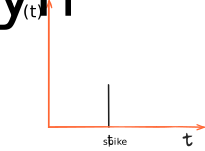
In case synaptic filtering can be neglected, the kernel
can be regarded as a Dirac delta function.
Exponential kernel
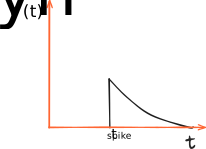
The exponential kernel is
with Heaviside function \(\Theta(t)=0\) for \(t<0\) and \(\Theta(t)=1\) for \(t\geq0\), and synaptic time constant \(\tau_\textrm{syn}\). The kernel is normalized to have a peak value \(k(0)=1\). The kernel corresponds to the solution of the ordinary first-order differential equation
with Dirac input at \(t=0\) and initial condition \(k(-\infty)=0\).
The synaptic filtering is implemented with an additional state variable for the synaptic current or conductance that follows the dynamics:
with spiking input from all presynaptic neurons. This dynamics is solved using Integrating neural models using exact integration [1].
Alpha-function kernel
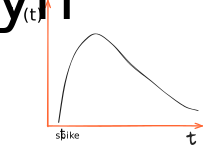
Alpha synapses (alpha) are defined by the filter kernel
with Euler number \(e\), Heaviside function \(\Theta(t)=0\) for \(t<0\) and \(\Theta(t)=1\) for \(t\geq0\), and synaptic time constant \(\tau_\textrm{syn}\). The kernel is normalized to have a peak value \(k(\tau_\textrm{syn})=1\). The kernel corresponds to the solution of the system of ordinary differential equations
with Dirac input at \(t=0\) and initial conditions \(\kappa(-\infty)=k(-\infty)=0\). The alpha kernel therefore represents the consecutive application of two exponential filter kernels.
Note that the above system of differential equations is equivalent to the second-order differential equation
with \(a=b=1/\tau_\textrm{syn}\) and initial condition \(k(-\infty)=0\) and \(\frac{dk}{dt}(-\infty)=0\) (ref Rotter Diesmann 1999). The solution to this equation for \(a=b\) is called alpha function which gives rise to the name alpha synapse.
The synaptic filtering is implemented with two additional state variables related to the synaptic current or conductance. These variables follow the dynamics described in the equations above and are solved using Integrating neural models using exact integration [1].
Beta-function kernel
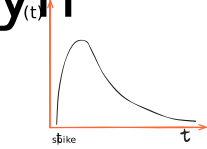
Beta synapses are defined by a kernel that is the difference of two exponentials :
This function allows for independent rise and decay times, as quantified by \(\tau_{\textrm{syn,rise}}\) and \(\tau_{\textrm{syn,decay}}\), respectively. The kernel is normalized to have a peak value \(k(t)=1\) at \(t=\left(\ln\tau_{\textrm{syn,decay}}-\ln\tau_{\textrm{syn,rise}}\right)/\left(\frac{1}{\tau_{\textrm{syn,rise}}}-\frac{1}{\tau_{\textrm{syn,decay}}}\right)\). The kernel corresponds to the solution of the system of ordinary differential equations
with Dirac input at \(t=0\) and initial conditions \(\kappa(-\infty)=k(-\infty)=0\). Note that this system of differential equations is equivalent to the second-order differential equation
with \(a=1/\tau_{\textrm{syn,decay}}\neq b=1/\tau_{\textrm{syn,rise}}\) and initial condition \(k(-\infty)=0\) and \(\frac{dk}{dt}(-\infty)=0\) [1]. For the case \(\tau_{\textrm{syn,rise}}=\tau_{\textrm{syn,decay}}\) please use the alpha synapse model instead. Even though the limit \(\tau_{\textrm{syn,rise}}\rightarrow\tau_{\textrm{syn,decay}}\) is well defined and coincides with the alpha synapse, there can be numerical issues as both numerator and denominator in the kernel equation beta kernel vanish in this limit.
The synaptic filtering is implemented with two additional state variables related to the synaptic current or conductance. These variables follow the dynamics described in the equations above and are solved using Integrating neural models using exact integration [1].